

Why Assisted Living and Memory Care Matter in Salida and Other Mountain Communities
Places to Age is building a 66-unit assisted living & memory care community in Salida, CO. Here's the plan, the cost, and the timeline.
Ashley Kappel, Jessica Chariton
5/2/20265 min read
Why Assisted Living and Memory Care Matter in Salida and Other Mountain Communities
Most people don't think about senior housing until it affects their own family. But in Salida and across Chaffee County, the lack of assisted living and memory care is already a documented crisis, and one nonprofit has spent over a decade working to fix it.
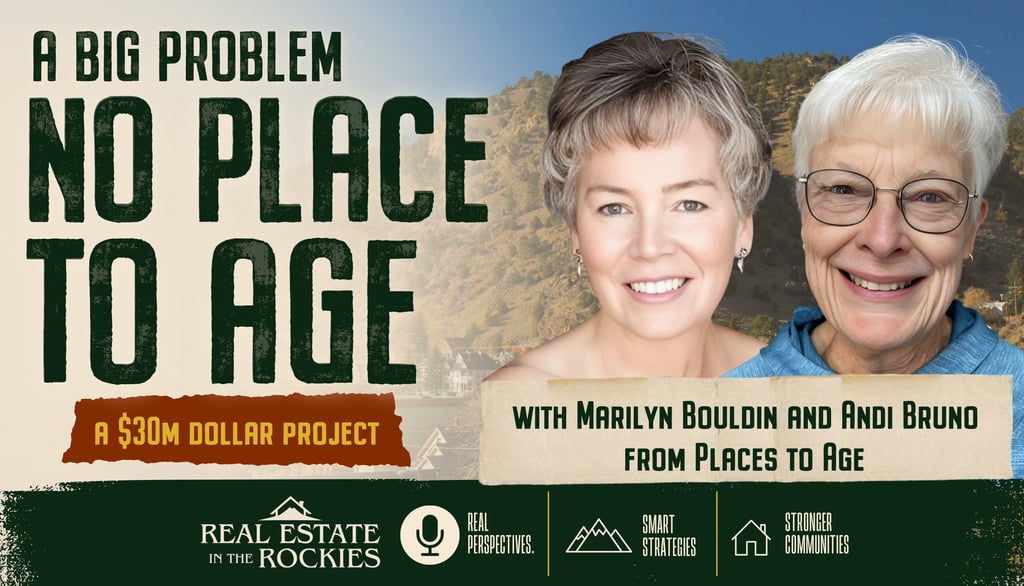
On this episode of Real Estate in the Rockies, Ashley Kappel and Jessica Chariton sit down with Marilyn Bouldin and Andi Bruno, founding board members of Places to Age, to talk through the group's $30 million project to bring senior housing to Salida, where things stand, what it costs, and when it might actually break ground.
👉 Listen to Episode 3 here| 🎧 Also on Spotify / Apple Podcasts / YouTube
Quick Answer: What Is Places to Age Building in Salida?
Places to Age is developing a 66-unit senior living community in Salida, Colorado, combining independent living, assisted living, and memory care. The $30 million project sits on donated land on County Road 120, near the Meadow Lark subdivision, with construction targeted to begin in Q2–Q3 2027 and take 15–18 months to complete. It's designed to serve Chaffee County, where 31.5% of residents are already 65 or older, a figure projected to hit 35% within four to five years.
The Problem: No Local Option for Aging in Place
Chaffee County has never had a true continuum of senior care. Marilyn Bouldin, former Director of Chaffee County Public Health, first identified the gap over a decade ago, when older adults were already having to leave the community to find supportive housing. A task force looked into the issue 10 to 12 years ago, but momentum stalled until Bruno and others revived the effort roughly three years ago, forming Places to Age.
Salida's existing skilled nursing facility, Columbine, illustrates the gap today. It has roughly 60 beds, but currently operates only about half of them due to staffing shortages, and it discontinued its memory care program several years ago. That leaves families with nowhere local to turn for assisted living or memory care, the middle of the care continuum most aging residents actually need first.
What "Continuum of Care" Actually Means
For anyone unfamiliar with senior care terminology, the continuum typically includes:
Independent living — living on your own, with no additional support
Assisted living — independent living with help such as medication supervision or transportation
Memory care — a secure unit designed for residents with dementia or Alzheimer's
Skilled nursing (SNF) — the highest level of care, for residents who are bed-bound or need medical equipment like a trach
Places to Age's planned facility will offer 66 total units, with 56 spread across independent and assisted living, plus dedicated memory care, filling the gap between "living at home" and "skilled nursing" that Chaffee County currently lacks entirely.
Why This Is Happening Now: The "Silver Tsunami"
The urgency isn't anecdotal. Andi Bruno, a former Silicon Valley business owner who returned to Colorado in 2019, pointed to the county's own demographic data on the episode: 31.5% of Chaffee County's population is currently 65 or older, a threshold the county didn't expect to hit until 2030, and the state demographer projects that number will reach 35% within four to five years.
That shift is already showing up in the local real estate market. Jessica Chariton, a Salida realtor, has sold numerous homes specifically because a family had to move an aging parent to Denver, Colorado Springs, or Pueblo for care they couldn't get locally, permanently separating them from their community and friends.
Learning From Other Mountain Towns
Before designing their facility, the Places to Age board toured comparable projects around Colorado, including Casey's Pond in Steamboat Springs, a highly regarded facility built on a pond in the middle of town.
The key lesson from Steamboat: don't overbuild. Casey's Pond broke ground in 2013 based on an ambitious market study, then ran into financial trouble before reaching stabilization, a problem compounded by the pandemic. Places to Age took the opposite approach, commissioning its own market study and deliberately sizing the project to about a third of projected demand, prioritizing long-term financial stability over scale.
Summit County is grappling with a similar shortage but faces an even steeper land-cost barrier and has been working the problem for eight to ten years without the benefit of a land donation, a hurdle Chaffee County has already cleared.
How the Project Is Being Funded
The $30 million project relies on a mix of financing sources:
Donated land — eight developable acres on County Road 120, part of a larger parcel donated to Places to Age (with additional acreage set aside for city parkland and potential workforce housing)
Bank financing — active conversations with multiple banks, including work toward a USDA loan guarantee
Grant funding — including a $2 million grant application submitted in partnership with Chaffee County government after an initial USDA direct loan request was denied
Community fundraising — a matching-funds campaign built on an anonymous $50,000 donation, plus a planned capital campaign for larger donors
The Workforce Piece
Staffing is one of the project's biggest open questions, Columbine's own struggles with staffing are a big reason it operates at half capacity. Places to Age is addressing this by carving out roughly one acre of its donated land for potential workforce housing, partnering with Colorado Mountain College on training programs like medication administration certification, and running a formal RFP process to select an experienced rural-Colorado operator before construction even begins.
What Happens If This Doesn't Get Built
The stakes go beyond the residents who'd live there. Losing aging residents means losing people who volunteer and contribute economically to the community, while also leaving existing housing stock unavailable to younger families and workers who might otherwise move into homes vacated as residents transition into senior care.
Frequently Asked Questions
How much does the Places to Age senior housing project cost? The project is currently estimated at $30 million, funded through a combination of bank financing, grants, a USDA loan guarantee application, and community fundraising.
How many units will the new facility have? 66 units tota, 56 across independent and assisted living, plus dedicated memory care units.
When will construction start? Groundbreaking is targeted for Q2–Q3 2027, with construction expected to take 15 to 18 months.
Where is the facility being built? On donated land on County Road 120 near the Meadow Lark subdivision in Salida, Colorado.
Why is senior housing such an urgent issue in Chaffee County? 31.5% of Chaffee County's population is already 65 or older, a level the county wasn't expected to reach until 2030, and that share is projected to hit 35% within four to five years.
How can someone in the community help? Through the Places to Age matching-funds campaign, a volunteer questionnaire, or the capital campaign for larger donors, all available at placestoage.org.
🎧 Hear the full conversation with Marilyn Bouldin and Andi Bruno on this episode of Real Estate in the Rockies, the full story behind the $30 million project, the lessons learned from Steamboat and Summit County, and what it'll take to get shovels in the ground.
👉Subscribe to Real Estate in the Rockies so you never miss the next episode.
Learn more or get involved: placestoage.org
Contact
Questions? Reach out anytime.
CONTACT
Collegiate Peaks Law & Mediation (719) 406-4111
Heart of the Rockies Homes (719) 334-8578
© 2026. All rights reserved.