

What It Takes to Develop Property in Mountain Towns
Developer Walt Harder breaks down zoning, off-market deals, and the real risks of developing property in Colorado mountain towns.Blog post description.
Jessica Chariton and Ashley Kappel
5/4/20265 min read
What It Takes to Develop Property in Colorado Mountain Communities
That new development going up in town? It's never as simple as it looks from the outside ,and almost nobody sees the regulatory fights, water negotiations, and years of relationship-building that happen before a shovel ever hits dirt.
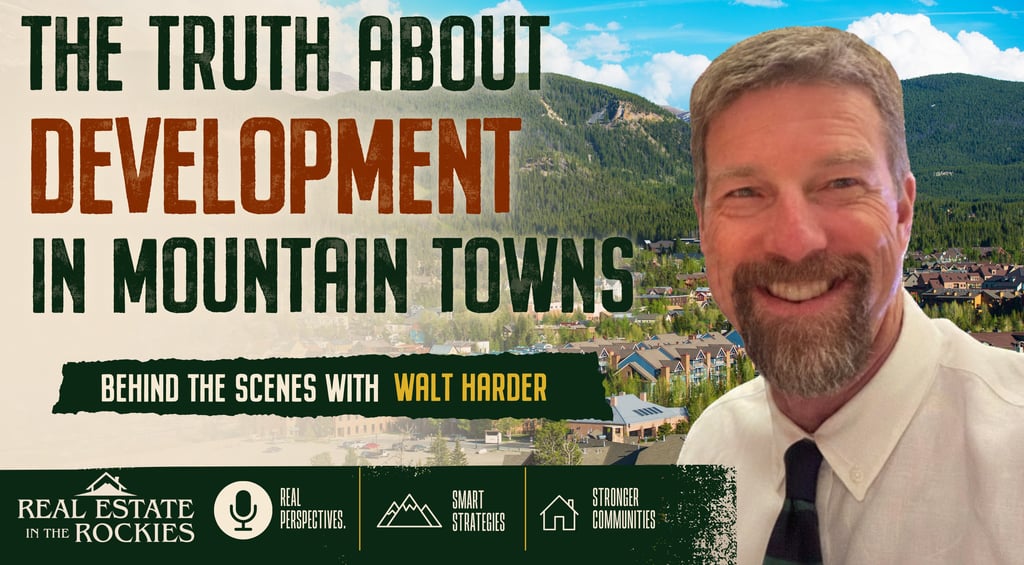
On this episode of Real Estate in the Rockies, Ashley Kappel and Jessica Chariton sit down with Walt Harder ,a Salida developer for over 25 years ,to talk through real deals, real numbers, and the debates (some of them heated) shaping how the town grows.
👉Listen to Episode 4 here | 🎧 Also on Spotify / Apple Podcasts / YouTube
Quick Answer: What Does It Take to Develop Property in a Mountain Town Like Salida?
Development in Salida takes deep local relationships, patience with a slow and expensive regulatory process, and a clear read on water rights ,one of the biggest hidden constraints in the Arkansas Valley. Developer Walt Harder, who's built commercial and multifamily projects in Salida since the early 2000s, argues that regulation and community pushback have slowed housing supply so much that it's a direct driver of the area's affordability crisis.
How Walt Harder Got Into Development
Harder moved to Salida around 1999-2000 after meeting his wife, a Salida native, in Colorado Springs. He got his start in real estate almost by accident: with no clients as a new agent, he convinced investors to buy a 44-acre parcel, subdivided it himself, and ended up with 12 listings. That one deal was what pulled him from selling real estate into developing it.
His long-running business partnership with John Diesslin started with a commercial project on Highway 50 ,a nearly two-acre parcel that had gone through foreclosure after two prior businesses failed. Harder eventually closed on the property for $763,500, then built out a Sherwin-Williams, Family Dollar, and AutoZone on the site, landing AutoZone as the anchor tenant by proving out local traffic and demographic data from his own car wash business nearby.
Why Regulation Is Driving Up Housing Costs, According to Harder
Harder's central argument is straightforward supply and demand: developers create housing supply, and when the regulatory process for approvals, studies, and reports becomes too expensive and too slow, that supply dries up, pushing prices higher for everyone already living in the community.
He points to persistent NIMBY ("not in my backyard") sentiment as a major driver of that regulatory drag, arguing that community pushback on new projects, combined with the cost of studies and reports required for approval, has made some projects untenable before they even start.
The Water Story Behind Salida's Growth
One of the more surprising threads in the conversation is water, specifically, how differently Salida and Buena Vista handled it. Salida sits on the Dry Union aquifer, a deep, well-recharged groundwater source that, according to Harder, could support the town tripling in size.
City administrator Julie Szymula led the purchase of the Vandaveer water rights in the mid-2000s ,a move Harder says looked risky at the time but turned out to be one of the smartest decisions the city ever made. Buena Vista, by contrast, didn't secure water rights as aggressively, and Harder says that's a major reason BV real estate traded at a 15-20% discount to Salida for years, before flipping to a premium once the Highway 285 corridor brought a wave of Front Range buyers discovering the area.
A Real Deal: Adobe Village and the Case for Workforce Housing
Harder and Diesslin bought the 32-unit Adobe Village apartment complex for roughly $100,000 per unit, gutted and refitted the units, and began selling them starting around $275,000 ,with values climbing to roughly $400,000 by the time they were done.
More recently, the partnership committed to building 100 workforce rental units in Salida over five years. They're currently at close to 50 units built, with another 60 in the pipeline. According to Harder, those units rent at or below 80% of the area median income (AMI) without any deed restriction requiring it ,because, in his words, that's simply what the local market supports.
Why Harder Opposes Deed Restrictions
This is one of the more pointed positions in the conversation. Harder argues that deed restrictions cap a property's long-term value, which removes the incentive for an owner to maintain or reinvest in it over time, comparing the effect to rent control policies, which he argues reduce supply and quality over the long run.
It's worth noting this is Harder's own position as a developer, not a universal industry consensus, other affordable housing models (including deed restriction, as used in projects like Buena Vista's The Crossing) take the opposite approach, using resale caps specifically to preserve long-term affordability. The debate over which tool works better is very much alive in Colorado mountain communities right now.
The 5HC Controversy: A Live Zoning Fight
Harder also discussed an active, unresolved dispute over a development referred to as "5HC" (also called "the back nine," located behind the golf course). The project has faced a lawsuit from nearby residents concerned about view impacts, and a possible referendum that would send the zoning decision to Salida voters in a future election.
According to Harder, the city originally zoned the parcel at a higher density (R-3) than his team requested, later reducing it to R-2 after community pushback, a sequence he describes as ironic, since he says the city has simultaneously pushed for higher density elsewhere to support affordable housing goals.
Looking Ahead: Salida in 20 Years
Asked where Salida is headed, Harder was direct: with a shrinking supply of large developable parcels left in the valley, he expects prices to keep climbing, not level off, barring a shift so severe it makes the area unappealing to newcomers altogether.
Frequently Asked Questions
Does Salida have enough water for future growth? According to developer Walt Harder, Salida sits on the well-recharged Dry Union aquifer and secured significant water rights in the mid-2000s, giving the city enough water capacity to potentially triple in size.
Are Walt Harder's workforce apartments deed-restricted? No. Harder says his roughly 50 built units (with 60 more planned) rent at or below 80% of area median income without a formal deed restriction, based on what the local market actually supports.
What is the 5HC development in Salida? Also known as "the back nine," 5HC is a Salida development that has faced a lawsuit from nearby residents over view concerns and a possible referendum on its zoning.
Why does Walt Harder oppose deed restrictions on housing? He argues deed restrictions cap a property's resale value over time, reducing the owner's incentive to maintain or reinvest in it, though other developers and affordable housing projects use deed restrictions intentionally to preserve long-term affordability.
🎧 Hear the full conversation with Walt Harder on this episode of Real Estate in the Rockies ,real numbers, real deals, and an unfiltered take on what it takes to build in a Colorado mountain town.
👉 Subscribe to Real Estate in the Rockies so you never miss an episode.
Learn more about Walt Harder's work: hred.co
Contact
Questions? Reach out anytime.
CONTACT
Collegiate Peaks Law & Mediation (719) 406-4111
Heart of the Rockies Homes (719) 334-8578
© 2026. All rights reserved.